
How the Suture Ease Product Portfolio Solves Challenges in Port Site Closure
Port site closure remains one of the most variable and, at times, arduous steps in laparoscopic surgery today. The Suture Ease System portfolio was built to solve that variability with reproducible, defect-matched closure devices. Each product targets a specific challenge, from routine trocar sites to large extraction defects in bariatric patients.
Surgeons face unpredictable suture placement, hard-to-locate fascial edges, and sharps exposure inside the peritoneum. Closure workflows also consume prime operating hours that hospitals need for higher-value surgical work. A portfolio approach gives you the right tool for each defect, patient, and case.
What Challenges in Port Site Closure Does the Suture Ease System Address?
The Suture Ease System addresses inconsistent suture placement, difficult fascial edge location, sharps exposure, and inefficient closure workflow. Each device targets a specific defect size, patient anatomy, or operating room safety concern. Surgeons gain reproducible closure outcomes without forcing one device to fit every possible scenario.
Why Fascial Closure Is a Persistent Challenge in Laparoscopic Surgery
Fascial closure looks simple on paper, yet remains one of the least standardized steps in laparoscopic surgery today. Surgeons work through small incisions with limited visibility, uncertain fascial edges, and inconsistent suture passer performance. Also, closure technique varies widely between surgeons, which introduces outcome variability the operating room cannot afford.
Personnel expenses account for 50 to 60 percent of total hospital operating costs, and surgeon time carries the highest weight. Consequently, every extra closure minute pulls the highest-cost OR resource away from higher-value surgical work.
Meanwhile, sharps exposure inside the peritoneum adds clinical risk during routine port site closure. Legacy techniques often require exposed sharps to locate and retrieve suture, creating avoidable safety concerns for the team. Furthermore, extraction sites and bariatric anatomy stretch older devices past their intended use case in daily practice.
The Suture Ease System was engineered to close the gaps legacy tools cannot solve at the port site. As a result, surgical teams gain reproducible technique, controlled sharps handling, and devices built for real anatomical variability.
How the Suture Ease System Simplifies Standard Trocar Site Closure
The Suture Ease System simplifies routine trocar closure by pairing snare-based guide technology with a purpose-built suture passer. Devices in the portfolio deliver reproducible suture placement, predictable fascial bites, and a workflow any trained team member can follow. Moreover, reproducibility is the bridge to delegation, and delegation is where hospitals capture real labor efficiency.
Reproducible Suture Placement - The proprietary snare guide places sutures at consistent depth and spacing across every port site.
Reduced Surgeon Time on Closure - Simpler mechanics free the highest-cost OR resource to focus on higher-value surgical work.
Enables Delegation to PAs and First Assistants - Standardized technique allows appropriate closure delegation without compromising patient care.
Fewer Steps and Fewer Instruments - Combined guide-and-passer design reduces handoffs, back table clutter, and workflow variability.
Standardized closure gives surgeons and hospitals a shared framework for training, staffing, and cost control across cases. Once the task is simplified and the outcome is reproducible, workforce optimization follows across the surgical service line. In turn, standard trocar closure becomes a delegated, teachable task rather than a variable surgeon-only workflow.
Solving Large Port and Extraction Site Closure With the Suture Ease System
Large defects behave differently from standard 10 or 12-millimeter trocar sites and demand devices built for the larger footprint. In addition, extraction sites in the 15 to 20 millimeter range require multiple sutures placed at controlled intervals for reliable approximation. The Suture Ease System addresses these defects with adaptor-based devices that support multiple stitch patterns and configurable placements.
Meanwhile, bariatric anatomy adds depth to the closure challenge, and standard-length devices often fall short in these patients. Extended-reach devices give surgeons the working length needed for the full patient population without switching platforms mid-case. Similarly, adjustable fascial bite features support surgeon control across variable tissue thickness in higher-BMI cases.
Consistent handling across defect sizes matters for team training, case predictability, and safe closure workflow. As a result, surgeons and staff move faster when large defects follow the same core technique as standard trocar closure.
Furthermore, confident device selection protects patients from the outcome variability that unmatched tools introduce during complex closures. Teams gain a predictable closure standard across every port they encounter in a laparoscopic procedure. Ultimately, hospitals gain closure standardization tied directly to operating room labor cost and workforce planning.
Matching Portfolio Devices to Patient Anatomy and Case Complexity
Device selection starts with the defect: standard trocar sites, large ports, and extraction sites each call for a different tool. Standard closure devices in the Suture Ease System handle routine 10 to 12-millimeter sites where reproducible placement is the primary requirement. Meanwhile, adaptor-based devices extend the same snare technology to large ports and specimen extraction openings in the 15 to 20 millimeter range while maintaining pneumoperitoneum.
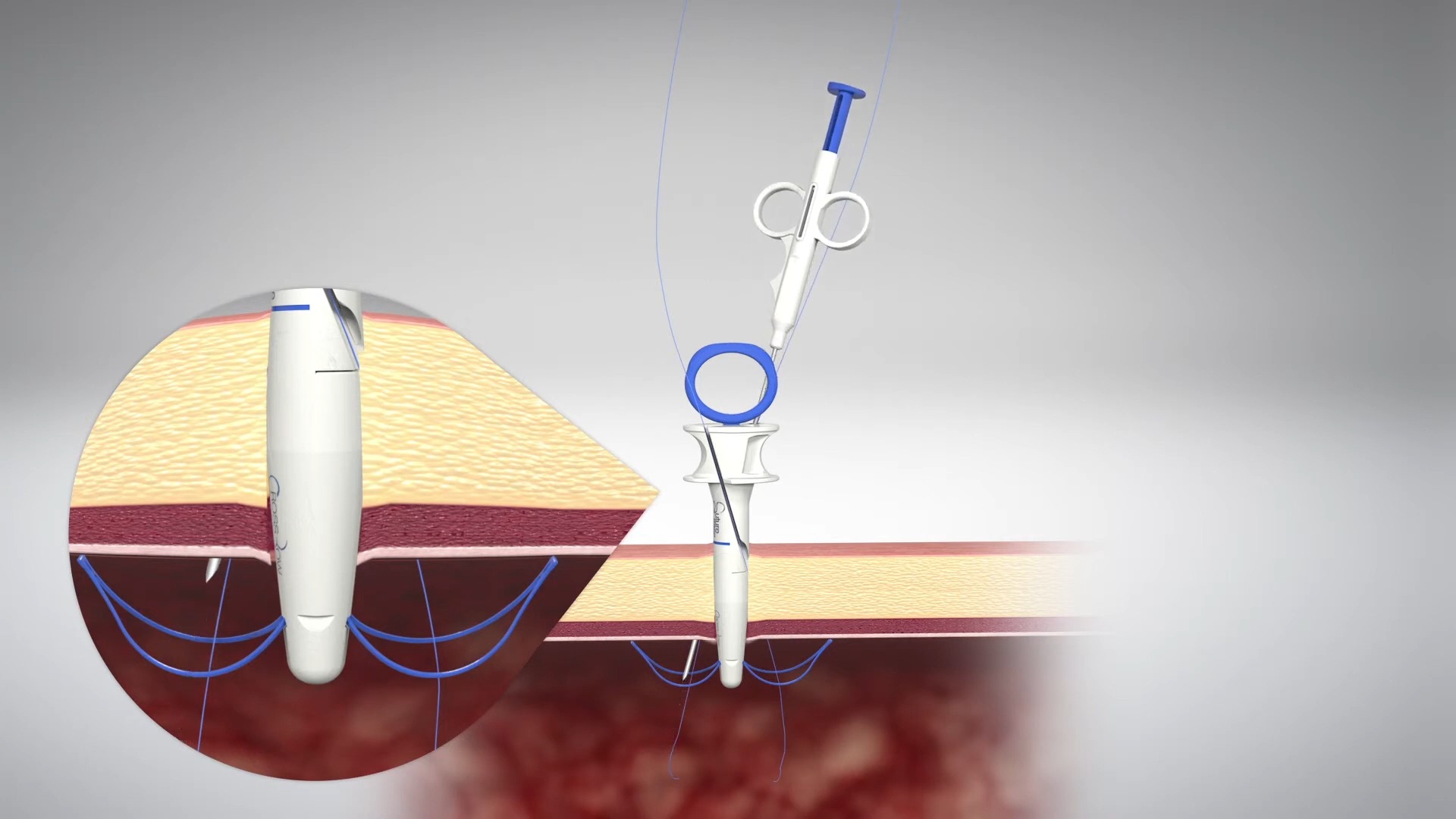
Patient anatomy is the next selection filter, particularly for bariatric and higher-BMI populations in general surgery practice. Additionally, extended-length devices reach fascia in patients where standard tools cannot achieve safe purchase without excessive angulation. Adjustable fascial bite features let surgeons control depth across variable tissue thickness within the same case.
Safety-forward devices add a further option for teams focused on eliminating sharps exposure inside the abdominal cavity during closure. Furthermore, notched guides replace exposed fingers on the fascial edge, and enclosed needle chambers keep sharps contained throughout the procedure. Reduced fat entrapment in the stitch also lowers the risk of fat necrosis and post-op skin dimpling.
Ultimately, portfolio matching aligns each closure decision with the right defect, the right patient, and the right safety profile. Surgical teams gain a repeatable framework that scales across service lines, case types, and staffing configurations. In turn, hospitals gain closure standardization needed to delegate appropriately and control operating room labor costs.
Ready to Standardize Port Site Closure Across Your Operating Rooms?
Suture Ease built its device portfolio around one goal: reproducible port site closure that supports surgeon efficiency, staff delegation, and controlled operating room labor cost. Every device in the lineup addresses a specific closure challenge, from standard trocar sites to bariatric extraction openings, without forcing one tool to fit every scenario.
Surgical teams gain a predictable closure standard, and hospitals gain a workforce optimization lever tied directly to their largest expense line. Contact Suture Ease to align the CrossBow platform and wider portfolio with your service line and closure protocols.


Comments