
The Impact of Precision Surgical Suture Tools on Tissue Health
The assumption that larger fascial bites produce more secure closures is intuitive but clinically incomplete. More tissue in the suture can seem to mean more structural strength. In practice, however, the relationship between bite size and closure quality is more complex, and the tissue health consequences of excessive bite depth are real and recorded.
Precision surgical suture tools are not simply an ergonomic refinement. They are a tissue outcome variable with direct effects on SSI risk, scar formation, patient comfort, and long-term healing. Understanding why precision matters in surgical suture tools is therefore essential to understanding how closure technique shapes patient recovery.
What Imprecise Surgical Suture Tools Do to Tissue
A closure stitch that pulls fat in alongside the fascial layer may start a chain of tissue events. Trapped fat has a poor blood supply and cannot handle normal cellular function under suture tension. Over time, it breaks down, producing skin dimpling, localized hardness, tenderness, and in some patients, a palpable post-operative mass.
Beyond pain and cosmetic problems, trapped fat also creates a warm, low-oxygen environment where bacteria grow with little immune resistance. Surgical site infection research identifies surgical technique and tissue handling as contributors to post-operative SSI risk. Also, excessive bite depth engages non-fascial tissue and may trigger a local tissue response. Therefore, SSI risk may rise when surgical suture tools fail to control fascial edge engagement precisely.
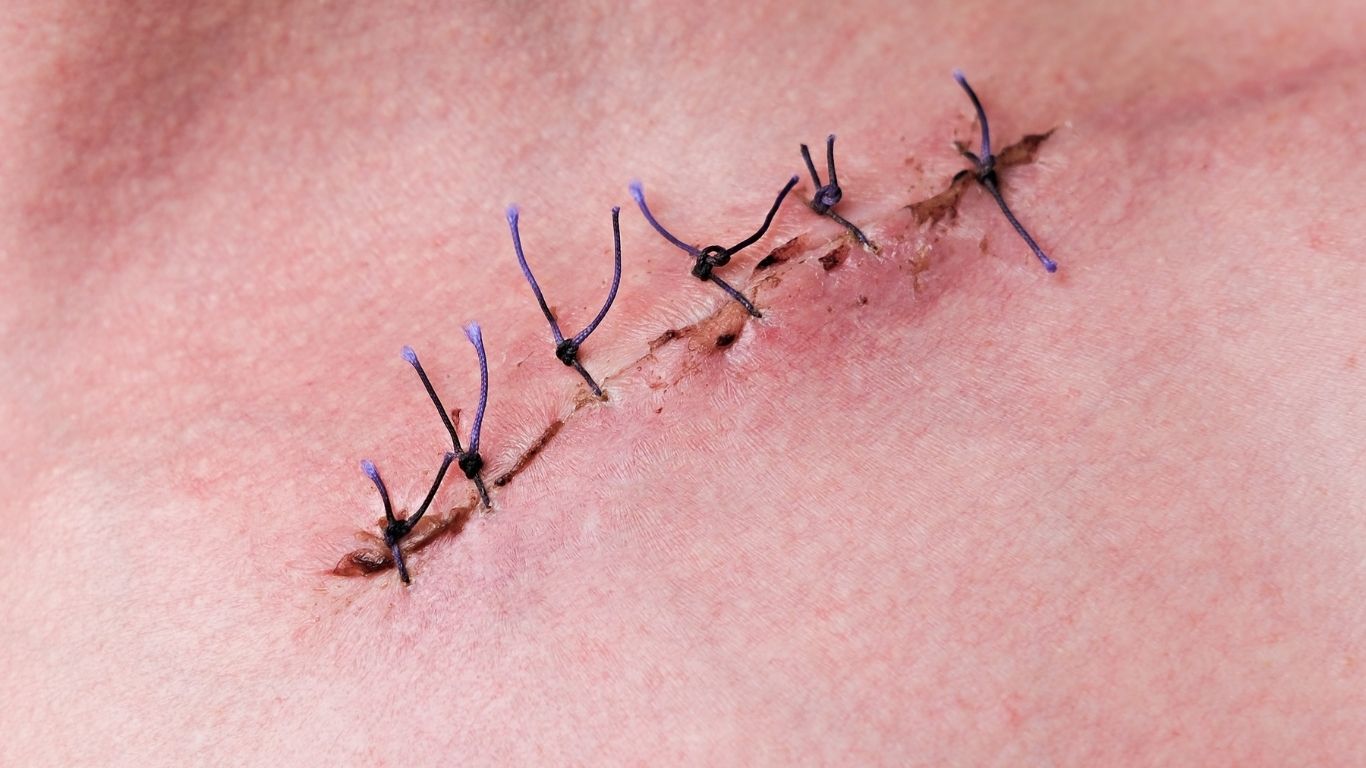
These three consequences, SSI risk, post-operative pain, and scar tissue, share a common origin in imprecise tissue capture. They also tend to show up together in the same patients. A patient who experiences elevated post-operative pain at a port site is often one whose closure technique produced uneven suture tension through imprecise tissue capture. Research comparing fascial closure technique and post-operative pain indicates that the closure method may directly affect pain scores. Addressing the root cause with precision surgical suture tools therefore may tackle all outcomes at once rather than managing each one separately after the fact.
Why the Tool Determines the Tissue Outcome
Surgical skill matters in fascial closure. However, skill alone cannot make up for a device that does not enable anatomy-specific tissue placement. A suture passer without guided fascial edge positioning leaves bite depth as a guess rather than a controlled variable. Under those conditions, even skilled surgeons produce variable results across patients. Moreover, that variation builds up across a demanding surgical schedule.
Precision surgical suture tools change this by giving the surgeon mechanical control over tissue engagement. When the device places the fascial edge into a set position before the pass, the bite grabs fascia specifically, at the right depth, without pulling in surrounding tissue. The result may promote less fat entrapment, less necrosis, less scar tissue, and better healing across the full patient population.
It is also worth noting that the benefit of precision surgical suture tools reaches beyond complex patients. Even in straightforward cases, controlled fascial edge engagement may produce more even suture tension, a cleaner healing path, and better cosmetic outcomes than guesswork-based placement. The difference may be less dramatic than in high-BMI patients, but it runs in the same direction across the full caseload: toward better tissue outcomes and fewer post-operative problems.
Precision Surgical Suture Tools at Larger Defect Sites
The challenge of controlled tissue engagement grows most acute at larger port sites and specimen extraction sites. There, surgeons may place multiple sutures, and even tension across a wider defect is desired. Imprecise placement across multiple bites creates zones of too much load next to zones of too little closure. So the combined effect on fat entrapment, scar formation, and healing may compound in ways that single-bite review does not reveal.
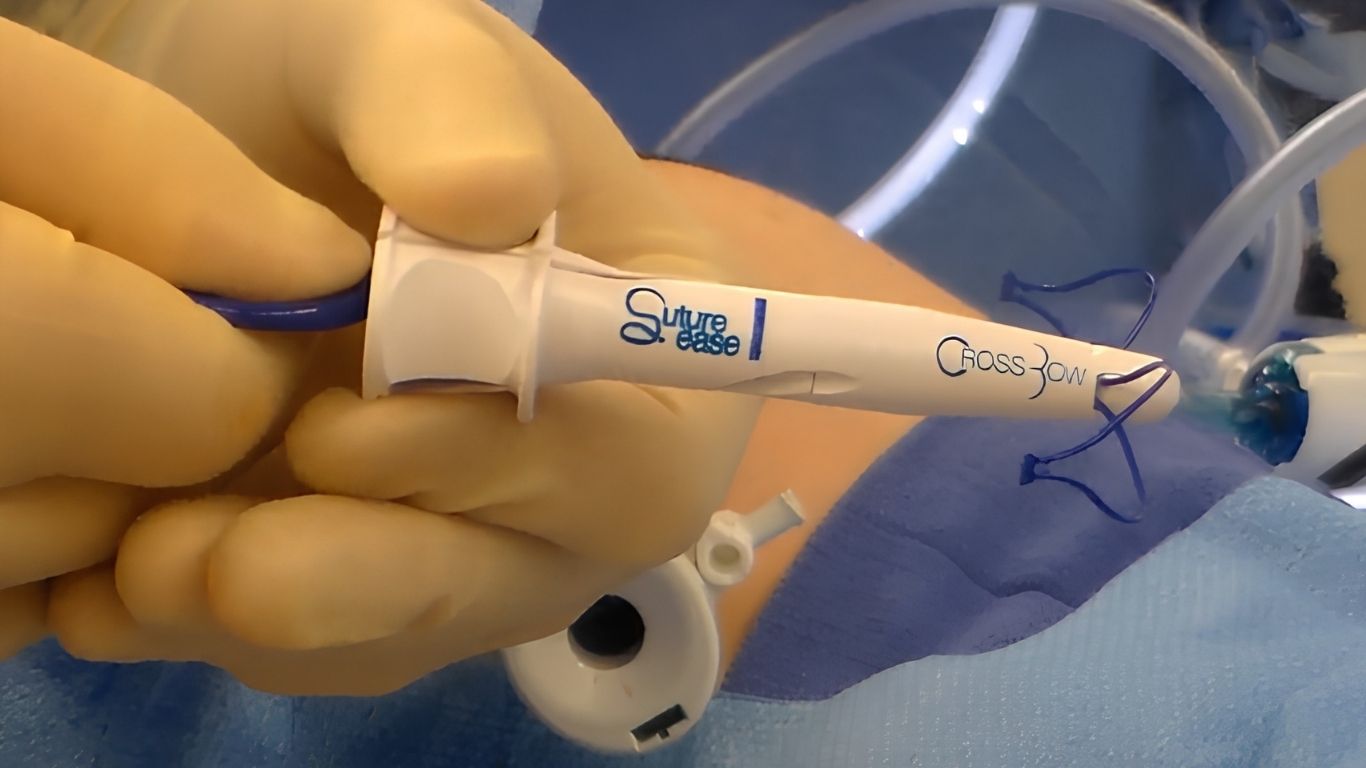
The CrossBow with Adaptor system extends precision closure to these larger defects. The proprietary snare guide technology keeps suture placement reproducible as its core function. Additionally, the Adaptor enables multiple sutures in an optimal stitch pattern across the full defect. It enables controlled placement at each bite point and promotes tension consistent across the entire closure.
Precision as the Starting Point for Better Patient Outcomes
The clinical conversation about surgical suture tools often centers on speed and ease of use. Both matter. They are, however, later considerations than the more basic question: what does the closure do to the tissue?
A fast closure that traps fat, causes necrosis, and builds scar tissue does not produce a good patient outcome, regardless of how quickly the surgeon placed it. Well-designed precision surgical suture tools make speed and tissue health work together rather than compete.
That combination is what modern laparoscopic closure should deliver on every case. Explore how the CrossBow with Adaptor addresses precision at larger defect sites at suturease.com/crossbow-with-adaptor.


Comments