
Reducing Surgical Time With a Semi-automated Surgical Suturing Device
- sutureease
- Mar 26
- 4 min read
In the modern O.R., “time is tissue.” A few minutes at the end of a laparoscopic case can extend anesthesia time, add fatigue to an already long procedure, and create avoidable variability between surgeons and teams, especially when the surgical suture device decision isn’t standardized.
One of the most common places this shows up is the final stage: port-site fascial closure. Moving from purely manual closure to a semi-automated surgical suturing device is one practical way to reduce that variability and make end-of-case workflow more predictable.
Why Manual Fascial Closure Becomes a Bottleneck
Manual closure is often “simple” in concept and inconsistent in execution, especially when patient anatomy and port location make the fascial layer hard to access. The time sinks are familiar:
The blind search: In deeper abdominal walls, locating the fascial edge by feel can take multiple passes and repeated angle changes.
The fumble factor: Coordinating a passer and retrieving the suture inside the cavity can require extra attempts, particularly when the geometry is awkward.
Inconsistent bites: A shallow or uneven bite can force a redo. Even when the closure is acceptable, uncertainty about capture can slow the team down.
The result is a closure step that’s difficult to standardize, even in otherwise standardized laparoscopic procedures.
How a Surgical Suturing Device Reduces Steps at the End of the Case
A semi-automated surgical suturing device doesn’t replace surgical judgment. It replaces the parts of the closure sequence that tend to vary: finding the fascia, achieving a consistent bite, and reliably capturing/retrieving the suture.
Standardized Precision: Guiding the “Bite”
Instead of “searching” for fascia, a guided system is built to help position the needle path more predictably. The point is not a bigger bite; it’s a more consistent one. When a team can reproduce fascial capture from case to case, closure becomes less dependent on “feel” and less sensitive to small changes in angle.
Integrated Snaring: Fewer Handoffs and Fewer Micro-Failures
One of the biggest slowdowns in manual workflows is suture retrieval. Devices that integrate a snare-loop concept simplify capture and retrieval into a single, continuous motion rather than a sequence of separate tool movements.
A predecessor snare-loop device evaluated in a small clinical series reported a mean closure time of 67 seconds (range 45–96 seconds) with uniform, symmetric stitch placement observed across cases. That kind of repeatability is what semi-automation is aiming to support: fewer attempts, fewer resets, and a closure step that behaves like a routine part of the procedure rather than a variable finish.
Surgical Suturing Device Performance in “Deep” Closure Scenarios
Closure difficulty does not scale linearly with patient size. In high-BMI cases, the distance from skin to fascia changes the angle, reach, and visibility that the surgeon has at the port site. That’s where teams see closure time drift upward and variability widen across operators.
A portfolio approach matters here. If the same closure workflow can be applied with an extended-length option, the team is not forced to “switch techniques” when anatomy changes. The goal is to keep the end-of-case sequence stable:
stable approach angle
stable capture/retrieval steps
stable confidence that the bite is where it should be
This is exactly why Suture Ease offers both CrossBow™ for routine closure and LongBow™ for deeper access scenarios.
Where Suture Ease Fits: Crossbow™ and Longbow™ as a Workflow Pair
Suture Ease focuses on the last few minutes of the case, where small inefficiencies compound and where closure quality still matters.
Crossbow™: Routine Port-Site Closure With Guided Capture and Snare Retrieval
CrossBow™ is designed to support reproducible fascial closure using a guided workflow and snare-loop retrieval concept. The practical benefit is fewer “search” motions and fewer retrieval maneuvers, especially when closing ports where teams want a consistent, repeatable process.
Longbow™: Extended Reach for Deep Fascia
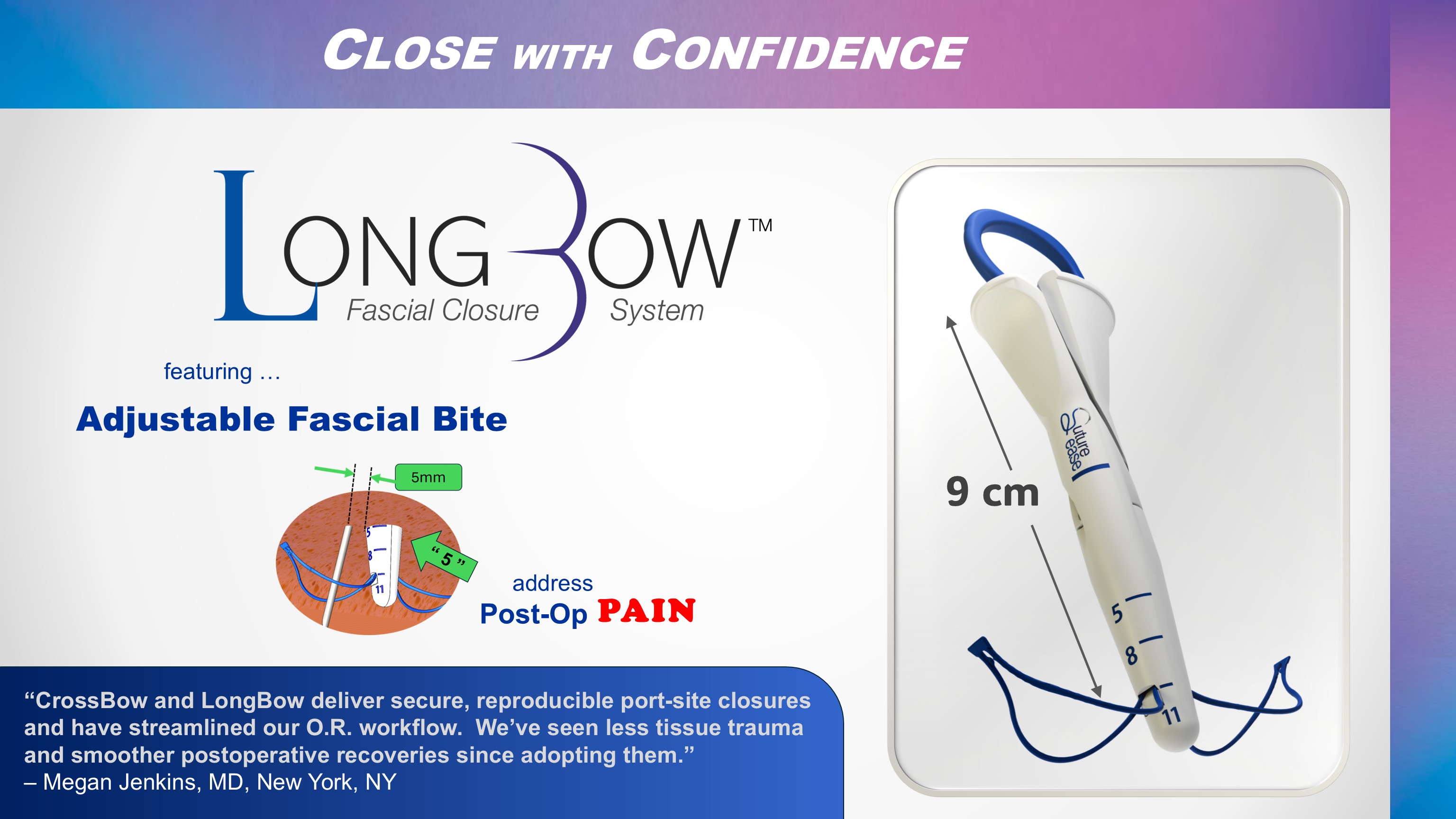
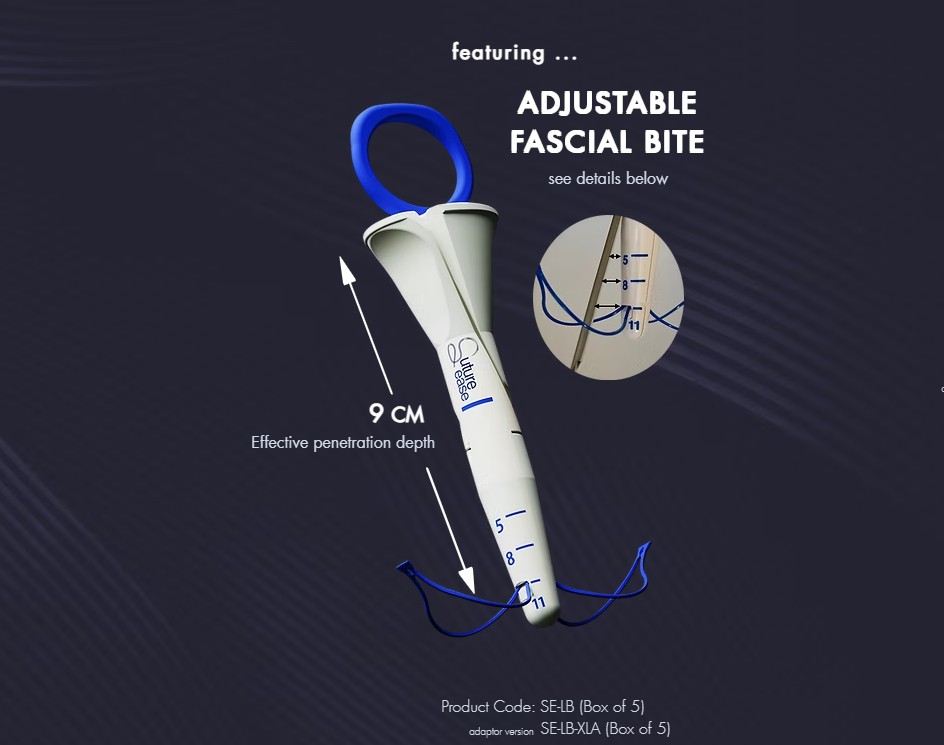
LongBow™ is built for the same closure objective but with extended length to help in deeper abdominal walls. In bariatric or high-BMI cases, extended reach can be the difference between a controlled closure sequence and a closure step that becomes improvisational.
Adjustable Bite Strategy When Tissue Quality Varies
Tissue quality can change the closure plan. A workflow that supports adjusting the bite to match tissue quality helps teams avoid a one-size approach, without turning closure into a bespoke technique every time.
What Administrators Should Measure: Predictability, Not Just Product Cost
For materials managers and O.R. leaders, the value of a surgical suturing device shows up when you measure consistency:
Does closure time vary widely between surgeons or service lines?
How often does closure require extra attempts or rework?
Does the team have a reliable approach for deeper port sites, or does it depend on individual technique?
In value-based environments, the downstream impact of a trocar site complication matters. Standardizing closure steps, especially for ports commonly associated with higher risk, supports quality initiatives and reduces avoidable variation in post-op pathways.
A Simple Comparison Table for Evaluation
Here is an at-a-glance look at the relationships between the outcomes of certain variables and closure techniques:
What You’re Trying to Control | Manual Closure (Common Friction Points) | Semi-Automated Surgical Suturing Device (Workflow Intent) |
|---|---|---|
Fascial identification | Can require repeated “feel-based” searching | Guided positioning supports predictable capture |
Suture retrieval | Often separate steps and tool coordination | Integrated snare-loop concept streamlines retrieval |
Attempt count | Can increase with depth/angle challenges | Designed to reduce re-attempts and resets |
High-BMI consistency | Technique changes as depth increases | Extended reach option maintains the same sequence |
Training standard work | Often operator-specific | Easier to teach as a repeatable sequence |
Pair Semi-Automated Surgical Suturing Devices With Suture Ease
A semi-automated surgical suturing device is not about rushing the end of a case. It’s about removing the avoidable friction that slows teams down: blind searching, repeated attempts, and inconsistent capture. When closure becomes a predictable sequence, surgeons finish strong, and hospitals gain a more consistent end-of-case workflow across patient types.
Contact us for more information about CrossBow™ and LongBow™ and how they can support faster, more consistent fascial closure.


Comments