
Mastering the Laparoscopic Knot Pusher for Faster Surgical Closure
- sutureease
- Apr 7
- 3 min read
Laparoscopic surgery demands precision within a confined operative space. Every instrument in the operating room has a defined role in achieving efficient, safe outcomes. The laparoscopic knot pusher is one tool that directly shapes closure quality and OR efficiency. Understanding how to use it well translates into faster procedures and improved patient recovery.
What a Laparoscopic Knot Pusher Does
Suturing inside the abdominal cavity presents unique challenges. Surgeons operate through narrow ports with a limited range of motion. A knot pusher acts as an extension of the surgeon's hand inside that space. It advances a pre-tied extracorporeal knot down the suture toward the target tissue. This mechanism allows firm, controlled knot placement without requiring direct manual access.
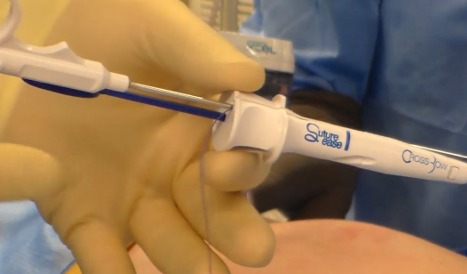
The device features a slender shaft and a specialized tip. These components guide the knot consistently to the operative site. Most designs accommodate both open-end and closed-end configurations. Each type offers distinct advantages depending on the procedure and surgeon preference.
Before knot pushers became standard tools, intracorporeal suturing required complex maneuvers with limited control. Over time, improvements in shaft rigidity, tip design, and ergonomics refined knot placement accuracy. Today, the instrument is a staple in general, urological, and gynecological minimally invasive procedures.
Extracorporeal vs. Intracorporeal Knot Tying
Surgeons can form knots either inside or outside the body. Extracorporeal knot tying involves creating the knot outside the patient. The knot is then advanced into the abdominal cavity using a knot pusher. Intracorporeal tying, in contrast, requires knot formation within the body itself using two needle holders.
Research supports extracorporeal techniques for both speed and accuracy. A 2024 randomized controlled study found extracorporeal tying was significantly faster and more precise. It also yielded tighter knots compared to intracorporeal methods. For surgeons developing their laparoscopic skills, extracorporeal tying offers a more accessible and reproducible starting point.
Common extracorporeal knot types used with a knot pusher include:
Roeder's knot. The most widely used sliding knot. Consists of a series of half hitches and is easy to master
Meltzer's knot. A modified variant that provides better locking after the knot has been advanced into the field
Mishra's knot. Designed for enhanced security. Slides smoothly and locks firmly at the target site
Laparoscopic Knot Pusher Clinical Applications Across Specialties
The knot pusher serves surgeons across multiple disciplines, making it a versatile tool across minimally invasive settings. In gastrointestinal procedures, it helps anchor anastomotic sutures and limit leakage risk. Gynecological cases rely on it for vessel ligation and tissue approximation. Urological surgery uses it for ligature placement during partial nephrectomy or prostate-related procedures.
Fascial closure at trocar sites is another essential application. Port openings of 10 mm or larger require thorough closure to prevent incisional hernias. These complications arise in 1% to 6% of laparoscopic cases. Proper knot placement at these defects is fundamental to patient safety and long-term recovery.
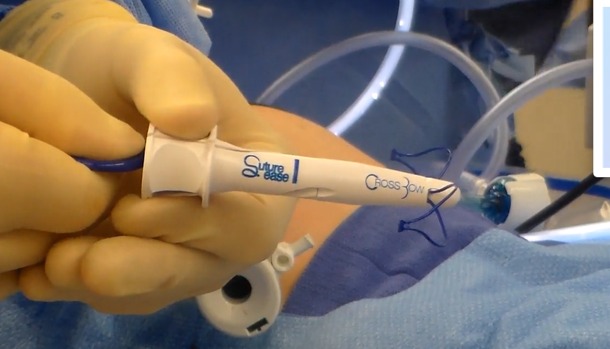
The knot pusher also plays a role in thoracic minimally invasive surgery. Despite the smaller operative field in thoracoscopy, the instrument's slender profile assists with bronchial closure after lobectomy.
Technique Factors That Improve Speed and Consistency
Efficient knot pusher use depends on more than instrument selection alone. Shaft stiffness matters significantly. A rigid shaft resists deflection during advancement, delivering the knot accurately to the tissue. Ergonomic handle design limits surgeon fatigue during extended cases. Tip geometry determines how precisely the knot reaches the intended site.suturease+1
Strong technique amplifies these design features. Consistent port placement ensures optimal instrument angles throughout the case. Maintaining suture tension during advancement prevents the knot from loosening prematurely. Verifying knot integrity before removing the instrument reduces the need for re-suturing. These habits, practiced regularly, accelerate closure without sacrificing quality.
Elevating Closure With Purpose-Built Devices
Mastering the knot pusher technique is a foundational skill for laparoscopic surgeons. Pairing that proficiency with purpose-built closure technology takes results even further. Suture Ease offers a comprehensive line of fascial closure devices designed to make port site closure faster and more reproducible. The CrossBow and LongBow Fascial Closure Systems utilize proprietary snare technology to simplify suture retrieval and placement. Both systems deliver predictable outcomes across a wide range of patient profiles.
The CrossBow addresses standard trocar sites with reliable precision. The LongBow extends that same capability to bariatric patients and larger body configurations. Suture Ease is the only company offering a full spectrum of closure options. These solutions address the varied demands of each surgical case.
Get in touch with Suture Ease to explore the CrossBow and LongBow systems and find the right closure solution for your OR.


Comments